

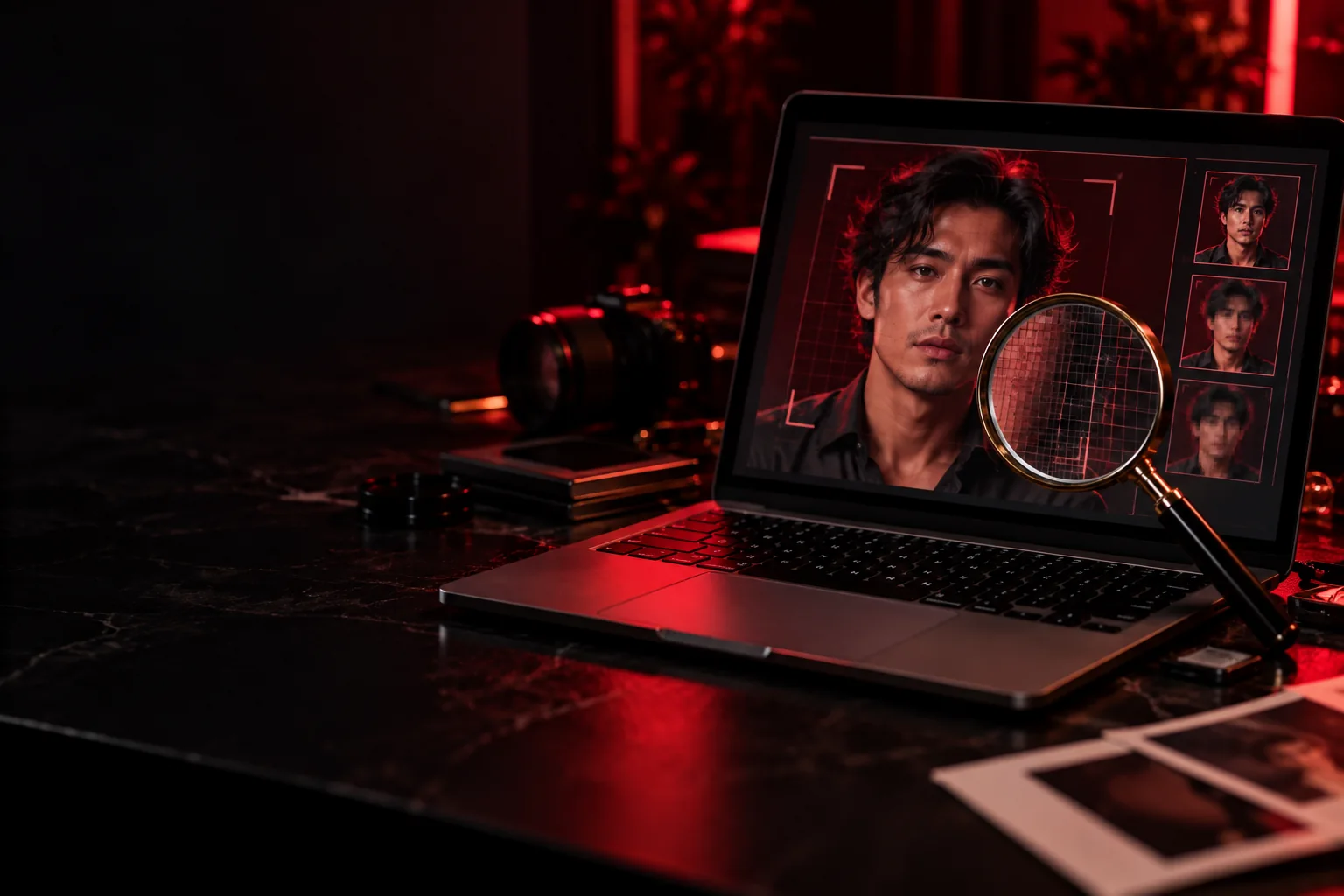
A deepfake detector is a useful first filter, not a verdict. The strongest check combines a detector score, a close look at the frames and the oldest copy of the file you can trace.
01How a deepfake detector reaches its score
Most detectors are classifiers trained on large sets of real and manipulated media. They look for traces a generator leaves behind: blending seams around the face, skin and hair texture that looks too smooth, compression that differs between the face and the background, or audio patterns typical of voice cloning. The result is a probability, often shown as a percentage and sometimes with a heat map of suspicious areas.
That score answers a narrow question: does this file resemble the fakes the model learned from? A new generator can slip past an older detector, and a heavily compressed WhatsApp forward confuses many tools because compression erases the fine traces they rely on. Provenance checks, covered below, work differently: they read a signed record or a hidden watermark instead of judging how the pixels look.
02How accurate are deepfake detectors
Less accurate outside the lab than headline numbers suggest, because real fakes rarely resemble the test sets detectors are scored on. Two public benchmarks show the gap.
| Benchmark | What it tested | Result |
|---|---|---|
| Deepfake Detection Challenge (Meta, 2020) | 35,109 submitted models, scored on 10,000 videos kept hidden from entrants | Winning model reached 65.18% on the hidden set |
| Deepfake-Eval-2024 (published 2025) | Fakes that circulated online in 2024, from 88 websites in 52 languages | Open-source detectors lost about 50% of their AUC, a standard accuracy score, on video, 48% on audio and 45% on images versus older datasets |
The same 2025 study found that commercial detectors and models retrained on recent fakes did better but still trailed trained forensic analysts. In practice: run more than one kind of check, and never post a detector percentage as proof that a clip is fake.
A 90% result means the file looks like fakes the model has seen, not that there is a 90% chance it was edited. Treat mid-range scores as unresolved and try a different type of check.
03Free deepfake detectors worth trying
No free tool is reliable alone. Combine a classifier, a provenance check and a reverse image search, since each catches problems the others miss.
- Hive AI Detector: a free Chrome extension from Hive that scores images, video, text and audio, and guesses which generator made an image or clip.
- SynthID check in the Gemini app: upload one file and ask whether Google AI made it. It is free for signed-in users, takes files up to 100 MB and videos under 90 seconds, and only recognises Google's own watermark.
- InVID-WeVerify plugin: a browser toolbox maintained by AFP Medialab that splits videos into keyframes for reverse image search and reads image metadata. A few advanced tools are reserved for journalists and researchers.
- Content Credentials verifiers: read the C2PA record that some cameras, editing apps and AI generators attach, showing how a file was made and edited. A missing record proves nothing, since many platforms strip metadata on upload.
Every upload to a checker creates a copy on someone else's server, so read the tool's privacy terms before submitting a clip of a real person. The questions in the face swap safety guide apply here too: how long the file is kept and whether it trains the model.
04How to spot a face swap in a video
Video face swap tools rebuild the face frame by frame, so the seams show up in motion rather than in a single still. Watch at full resolution, slow playback to 0.25x in YouTube or your phone's video editor, and pause on these moments:
- Head turns: the face slips, blurs or changes shape as the person moves into profile.
- Mouth and teeth: lips drift out of sync with speech, and teeth merge into a pale block.
- Edges: the jawline, ears and hairline flicker, double up or smear against the background.
- Objects in front of the face: a hand, microphone or pair of glasses warps the features as it passes.
- Light and skin: tone and shadows on the face do not match the neck, hands or room.
- Eyes: blinking looks rare or mechanical, or reflections differ between the two eyes.
One odd frame proves little, because compression and beauty filters create similar artefacts. Several signs together, plus a source you cannot trace, are a strong reason to doubt a clip. Short loops are harder to judge, since GIF face swaps have few frames and heavy compression, and in group swaps each face is worth checking, because one replaced face may carry different lighting from the rest. On a live video call, ask the person to turn fully sideways or pass a hand across their face; real-time swaps often break under both.
A detector score is a lead to follow, not a conclusion to share.
05What to do if you find a deepfake of yourself
Platforms, police and regulators in Malaysia ask for the same basic evidence, and a complete report moves faster.
- Save the evidence: the link, account name, date and time, plus screenshots or a screen recording of the post and its comments.
- Report the post to the platform as impersonation or manipulated media. Since 1 January 2026, the Online Safety Act 2025 has required licensed platforms to offer tools for reporting harmful content.
- If anyone asked for or lost money because of the fake, call the National Scam Response Centre on 997 immediately, since early reports give the best chance of freezing transfers.
- Lodge a police report and a complaint with MCMC, attaching the saved evidence.
- Warn family, friends and colleagues so they ignore calls or messages that appear to come from you.
Do not message the uploader or reshare the fake to debunk it, as that spreads the clip further. If the content harms your reputation or business, a lawyer can advise on a defamation claim. Many face swap apps need only one clear photo, so if you make swaps yourself, use only your own face or faces of people who agreed to it.
06Deepfake detector FAQ
How accurate are deepfake detectors?
Accuracy depends on how closely a file matches what the detector learned from. In Meta's 2020 challenge the winning model scored 65.18% on videos it had never seen, and a 2025 benchmark of real social media fakes showed open-source detectors losing about half their performance on video. Treat any single score as a hint and confirm it with a source check.
Is there a free deepfake detector?
Yes, several. Hive's AI Detector extension for Chrome is free and scores images, video, text and audio. The Gemini app checks files for Google's SynthID watermark at no cost for signed-in users, for files up to 100 MB and videos under 90 seconds. The InVID-WeVerify plugin helps with keyframes and reverse image search. None is accurate enough to be your only check.
How can I tell if a video is fake without a tool?
Play it slowly and watch head turns, the mouth, teeth, ears and hairline, where swaps break first. Check whether light on the face matches the neck and the room. Then look for the original: grab a frame, run a reverse image search and find the oldest upload from a trusted account. Visual glitches plus an untraceable source are a strong warning.
What should I do if someone made a deepfake of me?
Save the link, account name and screenshots before the post disappears, then report it to the platform as impersonation. If money was requested or lost, call the National Scam Response Centre on 997 straight away. Lodge a police report and an MCMC complaint with your evidence, and warn people close to you so they ignore messages that seem to come from you.
Sources (8)
- Meta AI: Deepfake Detection Challenge results
- Deepfake-Eval-2024: A Multi-Modal In-the-Wild Benchmark of Deepfakes Circulated in 2024 (arXiv)
- Hive AI Detector, Chrome Web Store
- Gemini Help: Verify AI-generated images, videos and audio
- Fake news debunker by InVID & WeVerify, Chrome Web Store
- Business Today: Online Safety Act kicks in, effective 1 January 2026
- Mayer Brown: Malaysia's Online Safety Act in focus
- New Straits Times: Call 997 immediately if scammed, says Fahmi